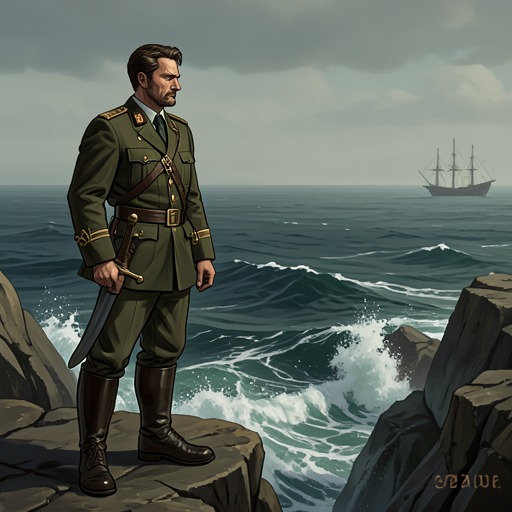
“The sin of doing”
The Leopard“The sin of doing” is the Prince of Salina’s stark formulation of what he sees as Sicily’s historical exhaustion: the island, shaped by centuries of rule from outside, has grown resistant to action itself. In his account, this resistance is not simply a judgment about whether reform succeeds. It is a condition in which doing anything becomes the offense.
Meaning and immediate context
Speaking to Cavaliere Aimone Chevalley di Monterzuolo, Don Fabrizio Corbera, Prince of Salina, distinguishes between the quality of an action and the act of undertaking it. His claim is explicit: “In Sicily it doesn’t matter about doing things well or badly; the sin which we Sicilians never forgive is simply that of ‘doing’ at all.” The phrase therefore describes more than ineffective government or opposition to a particular policy. It identifies a deeper aversion to intervention, in which action itself provokes resentment.
That distinction follows a disagreement over the Prince’s willingness to assist the new order. He has said he might support it without participating in it; his explanation makes the difference consequential. Support can remain distant, while participation would involve taking part in changes already set in motion without Sicilian consultation. The expression gives his refusal a historical and social rationale, presenting nonparticipation as consonant with a collective disposition rather than as a response to one appointment alone.
A history of imposed civilizations
The Prince connects this resistance to a long history of foreign rule. He describes Sicily as having borne, for more than twenty-five centuries, the weight of civilizations that were “all from outside, none made by ourselves, none that we could call our own.” He also calls the island a colony for two thousand five hundred years. In this account, the accumulated experience of outside authority has left Sicilians old and exhausted, not newly invigorated by political liberation.
His explanation is not framed as a simple accusation against outsiders. He says that Sicily’s condition is also its own fault, while insisting that centuries of externally imposed civilizations have shaped the island’s present. That combination makes the expression deliberately double-edged: it names a collective resistance to action, but also turns the judgment inward, treating passivity as an inherited condition for which Sicilians share responsibility.
The image of belated change
The surrounding exchange sharpens the phrase’s pessimism. When Chevalley suggests that Sicily is now free, the Prince accepts the good intention behind the claim but argues that it has come too late. He replaces the image of a young Sicily eager to see the modern world with that of a centenarian being taken around London’s Great Exhibition in a bath-chair, unable to understand or care about its factories and machinery and longing only to fall asleep again. The comic bleakness of the image makes political change seem not merely resisted but unintelligible to a society worn out by history.
“The sin of doing” thus works as both a social diagnosis and a warning about reform. If action itself is unforgivable, improving the conduct of a new government cannot by itself overcome the obstacle. The phrase turns the prospect of renewal into a paradox: Sicily may be declared free, yet the Prince sees no corresponding readiness to act, learn, or alter its habits.